Free-Tier AI API Failures in Production (Feb 2026)
Conclusion
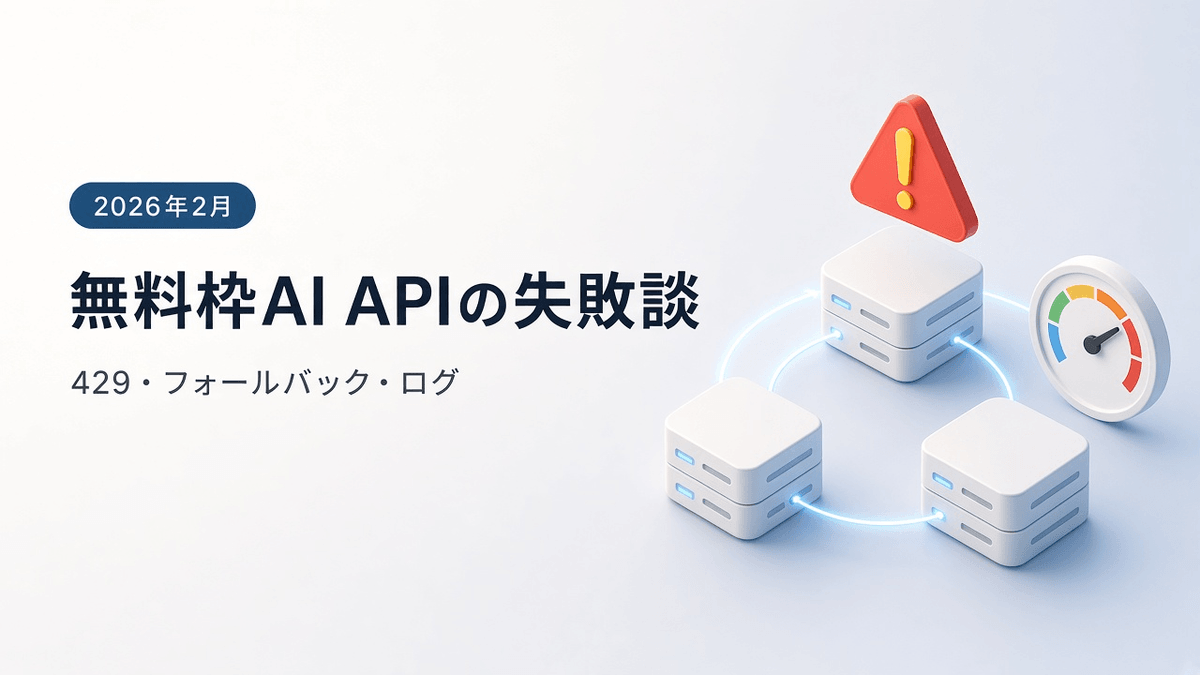
On kimura512.dev, the assistant feature runs on free-tier AI APIs. Free tiers must be treated as development environments: in production, robust fallbacks and rate limit observability are non-negotiable. In February 2026, night-time traffic spikes and abrupt model deprecations caused repeated incidents. Here is how I re-engineered the architecture to survive external outages.
1. Handling HTTP 429 Rate Limits
Even for a modest portfolio site, traffic bursts quickly trigger HTTP 429 Too Many Requests. My architecture chains three distinct providers in priority order. If the primary provider throttles, requests seamlessly cascade to the secondary and tertiary endpoints. The frontend displays a neutral loading indicator rather than exposing raw upstream provider names.
2. Managing Abrupt Model Deprecations
Vendor documentation models can disappear overnight without deprecation notices. Hardcoding model strings inside application handlers introduces fatal fragility. I externalized model identifiers into Cloudflare Workers environment bindings, enabling instant hot-swaps without code refactoring.
3. Observability Metrics That Matter
During incident retrospectives, I record timestamps (JST), provider identifiers, HTTP status codes, and estimated token counts. Vague intuition like "the API feels unstable" prevents root-cause diagnosis. Structured logging on the edge provides the factual foundation needed to renegotiate routing strategies.
4. The Incident of February 18, 2026
When Groq experienced an extended 503 outage, cascading traffic quickly choked downstream fallbacks. A dynamic feature flag allowed me to disable AI assistance instantly, preserving the core site for visitors. The following day, I reordered routing weights and tightened connection timeouts.
5. Lightweight Edge Monitoring
Rather than deploying heavyweight enterprise monitoring suites, I monitor a single synthetic endpoint and review weekly 5xx error distributions. Keeping operational overhead minimal ensures long-term sustainability for solo developers.
6. Circuit Breaking and Degraded States
When all external providers fail, the frontend degrades gracefully into a courteous advisory asking users to retry later, completely shielding internal stack traces.
7. Reviewing Terms of Service Quarterly
Commercial terms for free tiers change without warning. I maintain an audit calendar to review provider terms every quarter, documenting policy dates directly alongside deployment logs.
Operational Notes
Q. Can a solo service monetize entirely on free tiers?
It is possible for prototypes, but rate limits and sudden policy revisions make pure reliance risky. Architecture must remain decoupled from specific providers.
Q. Where do structured logs reside?
Workers logs and structured error events share a unified request correlation ID, making post-incident tracing straightforward.
Q. What error is displayed to the user?
Internal technical exceptions are hidden; the UI presents a clean, actionable prompt to retry shortly.