Why a Life Sciences PhD Switched to Indie Software Development: A Structural Analysis
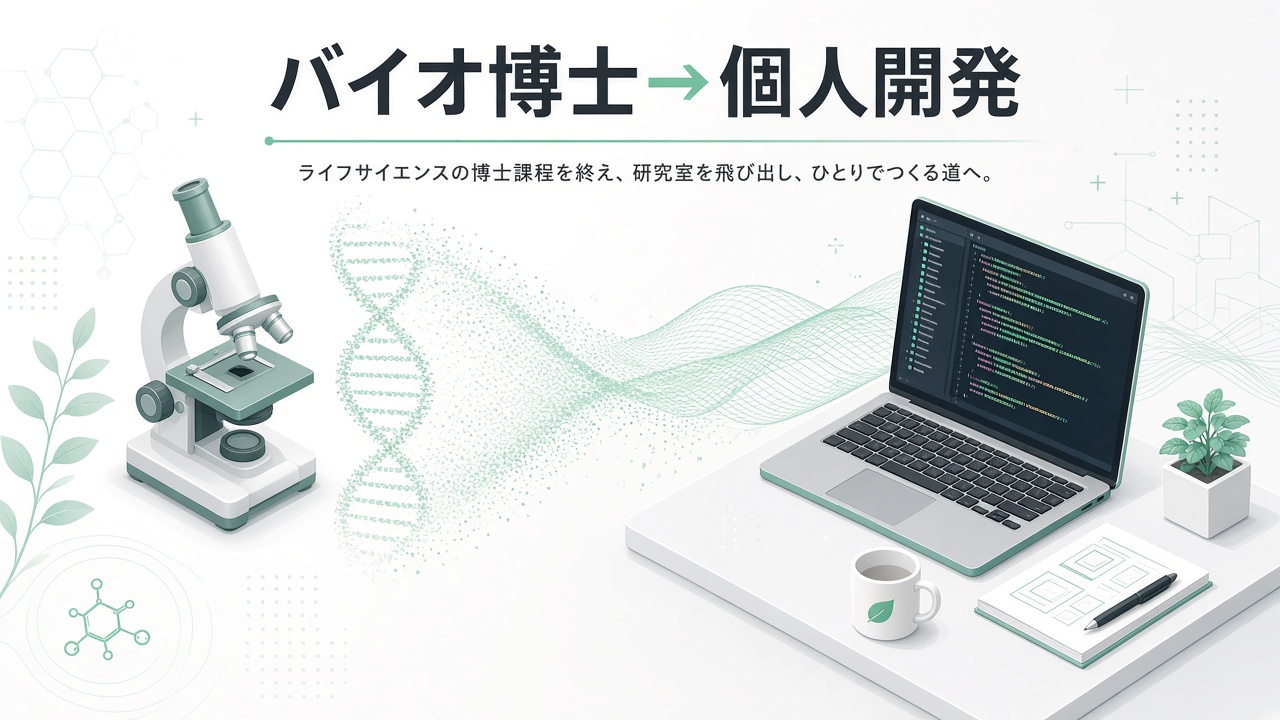
Why a Life Sciences PhD Switched to Indie Software Development: A Structural Analysis
⏱️ Reading time: approx. 8–10 min
Table of Contents
- Introduction: Why Trade the Lab Coat for a Laptop?
- Background: Academic Ambitions and Hard Realities
- The Structural Flaw of Biotech and 'I Am Legend'
- Why Indie Software Development: The Economics of Tech
- AI as Force Multiplier
- Survival Tactics: How to Fund Runway After Quitting
- Conclusion: Becoming the Owner of Your Life
- Disclaimer
1. Introduction: Why Trade the Lab Coat for a Laptop?
"You earned a PhD in life sciences—why on earth did you switch to indie software development?"
I get asked this all the time.
The answer is remarkably simple: "Because I wanted to hold the keys to my own livelihood."
This article is not a sentimental diary entry.
It is a pragmatic record of why a specialized researcher abandoned employment in institutional science to fight as an independent creator, framed through a comparison of industrial structures and survival strategies.
Who This Is For
- Researchers and specialized professionals feeling trapped in their current career trajectory.
- Anyone with zero formal software engineering background who wants to build their own products.
- People who have started to recognize how fragile traditional "stability" truly is.
2. Background: Academic Ambitions and Hard Realities
From the outside, my career began as a textbook sprint up the STEM elite ladder.
Raised in Kawasaki and Yokohama, I majored in life sciences through university and graduate school.
Immersing myself in molecular biology and neuroscience, after years of grueling bench work, I earned my Ph.D. in Life Sciences.
Transitioning into industry, I worked as a freelance medical writer for top global pharmaceutical firms and handled bioinformatics pipelines analyzing next-generation sequencing (NGS) data at a university.
Later, I joined a deep-tech biotechnology startup as a research scientist.
Cutting-edge science, brilliant colleagues.
From an external perspective, everything seemed smooth sailing.
Until I slammed face-first into the brutal mechanics of venture capitalism.
3. The Structural Flaw of Biotech and 'I Am Legend'
The biotechnology industry—especially drug discovery and deep tech—has a structural reality that is profoundly hostile to individual autonomy:
"It demands staggering amounts of capital."
Conducting experimental research requires multimillion-dollar lab equipment, specialized reagents, cleanrooms, and stringent biosafety certifications.
You cannot discover new therapeutics by peering into a hobby microscope in your living room.
In other words, to survive as a wet-lab researcher, you must continuously remain employed by an organization that owns the capital and lab infrastructure.
The lethal risk of this dependency surfaced during a wave of restructuring and layoffs at my startup.
When financial headwinds struck, management slashed burn rates aggressively.
Colleagues I had worked side-by-side with were handed pink slips overnight and escorted out.
In my team, I was literally the last person standing.
To put it mildly, it felt like being Will Smith in the movie I Am Legend.
It was a surreal, hollow feeling where laughing was the only alternative to screaming.
In that moment, lightning struck:
"No matter how advanced your specialized skills are, as long as someone else owns the means of production, your fate is decided at someone else's whim."
Remaining trapped in that structural power dynamic felt like an existential risk.
Approaching the major psychological milestone of age 40, I made my decision:
I will run my own business before turning 40.
And to make that happen, I am quitting this company.
(I should add that personal circumstances, including stress-related health issues, also contributed to my decision to resign.)
4. Why Indie Software Development: The Economics of Tech
How do you personally own the "means of production"?
During my accumulated paid leave before officially leaving, I dissected dozens of business models:
Consulting in my current field, small-business acquisitions, e-commerce, content publishing...
The answer I converged on was software development (Web & App Development).
I had always loved computers, taught myself programming, passed formal Japanese national IT certifications (FE, AP, and Registered Information Security Specialist), and routinely wrangled Linux servers for bioinformatics. Transitioning wasn't a blind leap into the dark.
Comparing the software industry to biotechnology revealed staggering structural advantages:
① Unmatched Capital Efficiency (Low Capital)
Biotech experiments demand multimillion-dollar wet labs; programming requires nothing more than a single laptop.
With just a computer and an internet connection, you can ship software accessible to millions of people worldwide.
The means of production can be funded completely out of pocket.
② Blazing Fast Feedback Loops (Fast Cycle)
Culturing mammalian cells takes weeks; compiling and executing code takes milliseconds.
This cycle speed directly determines how quickly you can iterate on failure, debug, and learn.
③ Compounding Ownership (Assets)
The code you write, the apps you publish, the user base you attract:
All of these remain your personal assets.
Even when you walk away from a day job, the software running on servers continues operating and generating cash flow.
This is polar opposite to academic research, where you must leave your laboratory notebooks behind upon resignation. In corporate research, even when your breakthrough wins patents, the intellectual property belongs entirely to the company, leaving the individual researcher with pocket change.
5. AI as Force Multiplier
"Wait, you never worked professionally as a commercial software engineer! Can you really catch up now?"
I hear that skepticism loud and clear.
It's a valid concern. While I had technical literacy, I had never worked inside a software engineering organization.
However, we now live in the era of ChatGPT, Claude, Gemini, Grok, and coding agents.
These are not merely chatbots. They are brilliant, tireless pair programmers working 24/7 without complaint.
As long as you understand systems architecture, user needs, and product logic, AI can generate syntax faster than human hands.
The hypothesis-testing rigor and structured logical deduction honed while earning a doctorate translate with uncanny synergy into steering AI models.
Using AI as a lever, the gap of a decade of traditional manual coding experience can be closed—or leapfrogged—in months of intense, focused building.
6. Survival Tactics: How to Fund Runway After Quitting
That said, acquiring modern dev skills, shipping products, and reaching profitability takes time.
How do you pay for groceries and rent in the meantime?
Here are public safety nets in Japan that many people either misunderstand or overlook entirely.
① Maximizing Unemployment Benefits
Let me be honest:
At first, I assumed, "Because I'm resigning voluntarily, I'll have to endure a 2-month waiting restriction and will only receive at most 3 months of benefits."
However, through thorough research before resigning, I discovered that I qualified as a "Job Seeker with Specific Legitimate Reasons" (特定理由離職者 - Tokutei Riyū Rishokusha).
This designation applies when an officially voluntary resignation was prompted by justifiable causes, such as stress-induced health complications documented during employment.
The concrete benefits I unlocked:
- ✅ Waiver of the 2-month restriction penalty period (payments began almost immediately).
- ✅ Extended total duration of benefit days.
- ✅ Substantial reduction in National Health Insurance premiums.
If I had assumed "I resigned voluntarily so I get nothing," I would have forfeited thousands of dollars in legitimate public support.
📖 Read the deep dive
I wrote a complete practical guide on Japanese unemployment and social insurance systems:
👉 Using Japanese Unemployment and Social Insurance Before a Job Change (2026 Edition)
② Public Vocational Training (Hello Training)
Even if you do not qualify under special health circumstances, there is another powerful public avenue: Public Vocational Training (公共職業訓練).
When enrolled in training programs administered through public employment offices (Hello Work):
- Waiver of penalty periods: Benefit payouts begin immediately without waiting restrictions.
- Extended coverage duration: Benefits continue for the full duration of the training curriculum (e.g., 6 months).
- Potential extensions even post-completion.
In effect, you receive a legitimate public stipend for 6 to 12 months while dedicating your full working hours to acquiring new marketable skills. This is not exploiting a loophole; it is the exact statutory purpose of workforce reskilling.
Instead of rushing into another toxic workplace out of financial desperation, you secure the runway to carefully choose your next move or build your own indie software business.
③ Retaining Daycare / Childcare Placement
For families with small children, the most terrifying cliff when quitting a job is losing daycare spots.
Public daycare eligibility is tied to employment. In high-demand metropolitan areas, if one parent becomes unemployed, children are often removed from the nursery, forcing you into full-time childminding at home and vaporizing your reskilling runway.
I navigated this challenge by enrolling in an approved course under the Specified General / Specialized Practice Education and Training Benefit (専門実践教育訓練給付金).
Under this framework, the government covers 50% to 80% of tuition fees for certified professional courses.
Furthermore, many municipal governments recognize "Education / Vocational Study" (就学) as a valid qualifying condition for public childcare.
I enrolled in an online software academy designated as an eligible training program. In collaboration with the school, I established a verified study schedule exceeding 120 hours per month (equivalent to full-time hours) and submitted verification documents to the municipal welfare office.
As a result, my child's enrollment was preserved without interruption, giving me full-time daytime hours to immerse myself in programming and product development.
(Always verify specific childcare qualification hours and required documentation directly with your local municipal ward office, as local administrative policies differ.)
7. Conclusion: Becoming the Owner of Your Life
I genuinely loved biological research, but I could no longer accept an industrial structure where I was powerless without an institutional employer.
So I leaped into the world of software, where a single laptop can reach the world.
- Analyze the industrial structure you operate in.
- Own your means of production.
- Leverage AI aggressively.
- Utilize public safety nets legally to secure precious runway.
All of these principles point to a single objective: refusing to let others dictate your survival, and becoming the rightful owner of your life.
If you currently feel battered and exhausted by corporate politics and organizational reorganizations, pause and ask yourself:
"Will the skills I am building today still protect me when I leave this company?"
I will never forget the expressions of my former teammates who were abruptly terminated during our startup's layoffs.
Some might say: "Isn't that just survivor guilt talking?"
Think whatever you want. I don't care.
I will never forget the raw frustration of that moment.
I converted that fury into fuel to build my own independent products.
So that no one will ever hold the power of life and death over me again.
There is zero shame in being an employee. In fact, you should leverage employment intelligently.
Keep your day job while reserving energy to construct your independent assets. If your day job directly feeds skills into your personal venture, even better.
"Do not let the company use you. Use the company."
8. Disclaimer
The views and experiences shared in this article reflect the author's personal career path and do not guarantee future commercial success or financial outcomes.
Details regarding Japanese public benefit systems and training subsidies reflect policies as of early 2026 and vary based on individual circumstances and local municipalities. Always consult directly with competent authorities such as Hello Work.