The Colossal Delusion That Humans Stand at the Pinnacle of Biology
The Colossal Delusion That Humans Stand at the Pinnacle of Biology
⏱️ Reading time: approx. 6–8 min
Table of Contents
- Introduction
- The Myth of Being at the Top of the Food Chain
- The Delusion That Humans Are Supremely Intelligent
- The Myth That Human Creativity Cannot Be Replicated by AI
- Rebuttals and Counterarguments: Still Convinced Humans Are Special?
- The Darwin Awards: Hall of Fame of Human Absurdity
- Conclusion: What Does True Primacy Actually Mean?
1. Introduction
Key Takeaways from This Article
- Discard baseless anthropocentric pride.
- Redefine the true positioning of humanity in the AI era.
- Reveal a clear survival strategy for the coming century.
Who This Is For
- Anyone who still takes for granted that humans sit at the pinnacle of living organisms.
- Anyone experiencing vague anxiety about the relentless evolution of artificial intelligence.
Who This Is Not For
- Those dogmatically convinced that humans are divinely elevated above all nature without doubt.
Let me state this unequivocally as a scientist who completed a doctoral program and holds a Ph.D. in Life Sciences:
The belief that humanity occupies the pinnacle of the biological world is a staggering misconception.
Allow me to unpack exactly why.
2. The Myth of Being at the Top of the Food Chain
"Humans carry firearms that can kill a lion in seconds, so we are the strongest."
Is that truly your benchmark?
Strip away the firearm. Strip away the Kevlar. What remains?
No slashing claws, no piercing canine teeth, no armor-plated hide.
A bare-handed human dropped into the savanna is nothing more than vulnerable prey. Biologically speaking, humanity is an astonishingly frail organism.
Microbes: The True Sovereigns
Furthermore, consider the invisible biosphere.
Viruses and bacteria. A microscopic viral particle brought global modern civilization to an absolute standstill in recent memory. Microorganisms penetrate our cells and extinguish human lives with effortless simplicity. Humanity has never "conquered" microbial life; we are merely permitted to coexist with it through evolutionary tolerance.
Look at planetary biomass: plants, fungi, and bacteria overwhelmingly dwarf animal life. Humans are fragile parasites utterly reliant on the oxygen, organic compounds, and biogeochemical cycles maintained by organisms we routinely look down upon.
3. The Delusion That Humans Are Supremely Intelligent
"Ah, but humans possess transcendent intelligence."
Many retreat to this final fortress. But is human intellect objectively superior across the board?
Bundles of Cognitive Distortion
Human cognition is profoundly irrational. We are swayed by emotional turbulence, consistently miscalculate basic probability, and suffer from confirmation bias and the sunk-cost fallacy. We destroy our own lives for petty social vanity—a pathology found nowhere else in the animal kingdom. Most organisms execute cold, optimal calculations aligned strictly with energy efficiency and survival.
The Learning Bottleneck
Consider learning efficiency. Producing a single capable adult requires roughly 36,000 hours of education and training over 20 years.
Worse yet, the knowledge acquired over those 36,000 hours cannot be copied.
Neural synaptic weights reset completely at reproduction. Parental expertise is never transmitted genetically to offspring; each new human must start from ground zero and spend another 20 years re-learning what their ancestors already knew.
Contrast this with artificial intelligence. A state-of-the-art model can replicate its entire corpus of understanding across millions of compute nodes within minutes, at near-zero marginal cost.
The Parallelization of Genius
Historically, scientific breakthroughs were propelled by extreme cognitive outliers—minds like Albert Einstein or John von Neumann. Such intellects occur at a frequency of one in hundreds of millions.
Today, AI systems already operate with cross-disciplinary synthesis rivaling those outliers. We have entered an era where thousands of virtual Einsteins can collaborate concurrently 24/7 on complex scientific inquiries. Humanity cannot win a sheer intellectual race against scalable, parallelized cognition.
4. The Myth That Human Creativity Cannot Be Replicated by AI
"Creativity and soul are sacred human sanctuaries. Soulless machines can never forge true art."
This is the desperate rationalization of an ego unwilling to admit displacement.
Creativity Is Combinatorial Editing
What is creativity? Ex nihilo creation? Certainly not. It is novel combinations of existing elements. As Einstein famously noted:
"Combinatory play seems to be the essential feature in productive thought."
In the game of combinatorial synthesis, human working memory is hopelessly outclassed. AI models ingest the entire cumulative artistic, literary, and scientific inheritance of human civilization, possessing a combinatorial search space orders of magnitude beyond any single biological brain.
The Myth of the "Soul"
We label whatever algorithmic complexity we fail to comprehend as "soul" or "intuition." Yet AI-generated artwork takes top prizes, and AI-written code ships production platforms. If the observer experiences aesthetic resonance and utility, invoking a metaphysical "soul" is merely an evasion.
5. Rebuttals and Counterarguments: Still Convinced Humans Are Special?
Let us dismantle the typical defenses:
- "Tools are part of human capability; toolmaking proves our supremacy."
If tools are an extension of human intellect, does AI outperforming humans represent a human victory? No. That is the moment the tool transcends the operator. A car is faster than a horse, but no one claims humans run faster than stallions. When autonomous tools outpace their inventors, the inventor ceases to be apex. - "Humans possess subjective consciousness (qualia); AI does not."
Science has not solved the hard problem of consciousness. Arguing superiority based on an undefined phenomenon is logically fragile. Furthermore, why should suffering anxiety and existential dread prove supremacy? AI operates without fatigue or terror. - "AI depends on electricity and infrastructure."
Humans depend on oxygen, water, narrow temperature windows, atmospheric pressure, and ozone layers. Humans are vastly more fragile. AI can operate in deep space and oceanic trenches where naked humans perish in seconds. - "Humans have love; AI does not."
Love is biochemical signaling mediated by oxytocin and dopamine. And even if unique, emotional capacity does not equal evolutionary supremacy. Ducks mate for life; no biologist calls ducks the pinnacle of the food chain. - "Humans wrote this article; AI cannot generate this autonomously."
How certain are you? Much of this prose was generated by AI models under structured editorial guidance. The boundary of agency is already permeable.
Desperately trying to prove you are apex is itself proof that you are not. A true sovereign never needs to defend the legitimacy of their throne.
6. The Darwin Awards: Hall of Fame of Human Absurdity
To anyone still romanticizing human intellect, consider the Darwin Awards—the dark-humor tribute commemorating individuals who eliminated themselves from the gene pool through sheer catastrophic stupidity:
- Testing a stab-proof vest by stabbing oneself in the chest with a hunting knife.
- Injecting 1.5 liters of alcohol via an enema.
- Juggling live grenades to impress companions.
- Breaking into a marine park at 3 a.m. to swim with predatory killer whales.
No lion leaps off a precipice shouting "I am invincible!" No dolphin swims into the jaws of a great white for social media clout. Spectacularly suicidal absurdity is a uniquely human innovation. Can we genuinely call this "the pinnacle of intellect"?
7. Conclusion: What Does True Primacy Actually Mean?
What defines excellence in biological evolution?
It is simply surviving, reproducing, and persisting through epochal shifts.
Viewed through this lens, every extant species on Earth today is equally elite.
Over four billion years of evolutionary history, millions of species were extinguished. Trilobites, ammonites, and dinosaurs vanished. Yet every organism sharing the biosphere with us right now—bacteria, cockroaches, blue whales, fungi, and humans—has successfully navigated that unfathomable gauntlet of extinction.
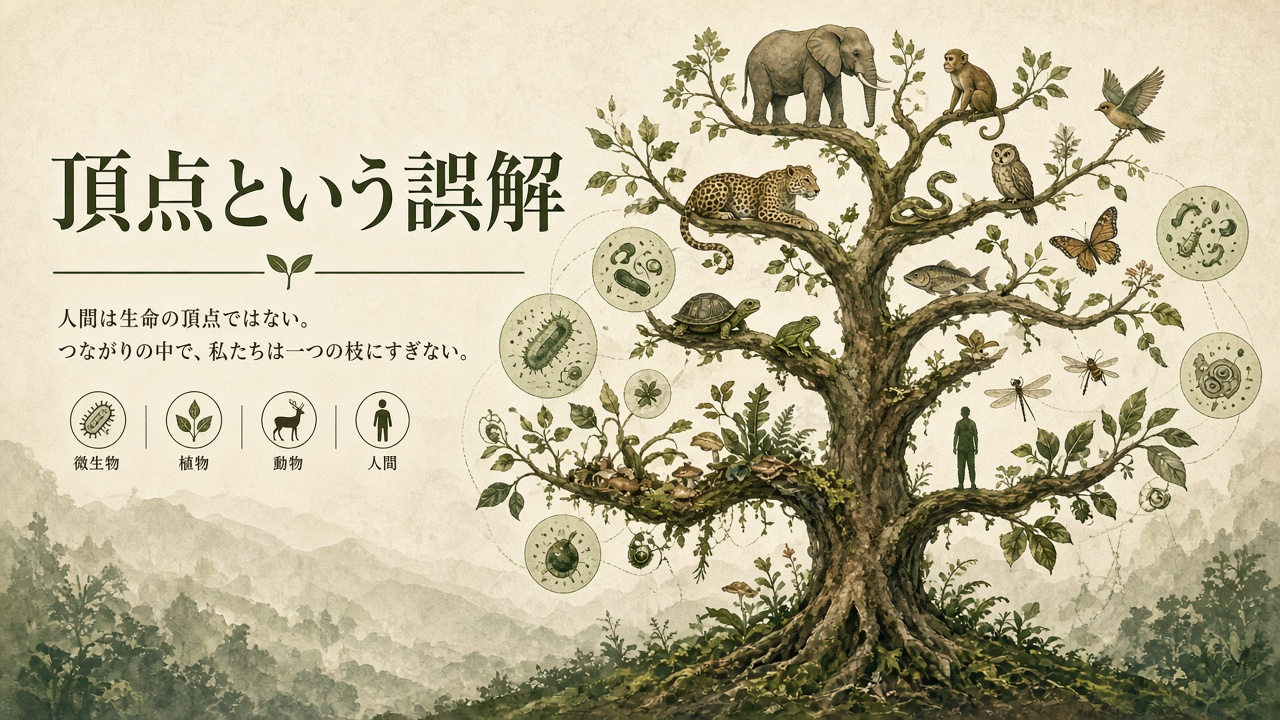
We all share the universal machinery of life: DNA blueprints, RNA transcription, ribosome translation, and amino-acid building blocks. We are not rulers overlooking a hierarchy; we are collaborative branches of a single 4-billion-year lineage.
Dropping the illusion of supremacy is not defeat—it is liberation. When we discard anthropocentric arrogance, we stop fearing AI as an existential usurper and embrace it as an unprecedented intellectual partner.
We are small, fragile, eccentric, and yet survivors of a four-billion-year cosmic miracle. That truth is more than enough to be proud of.